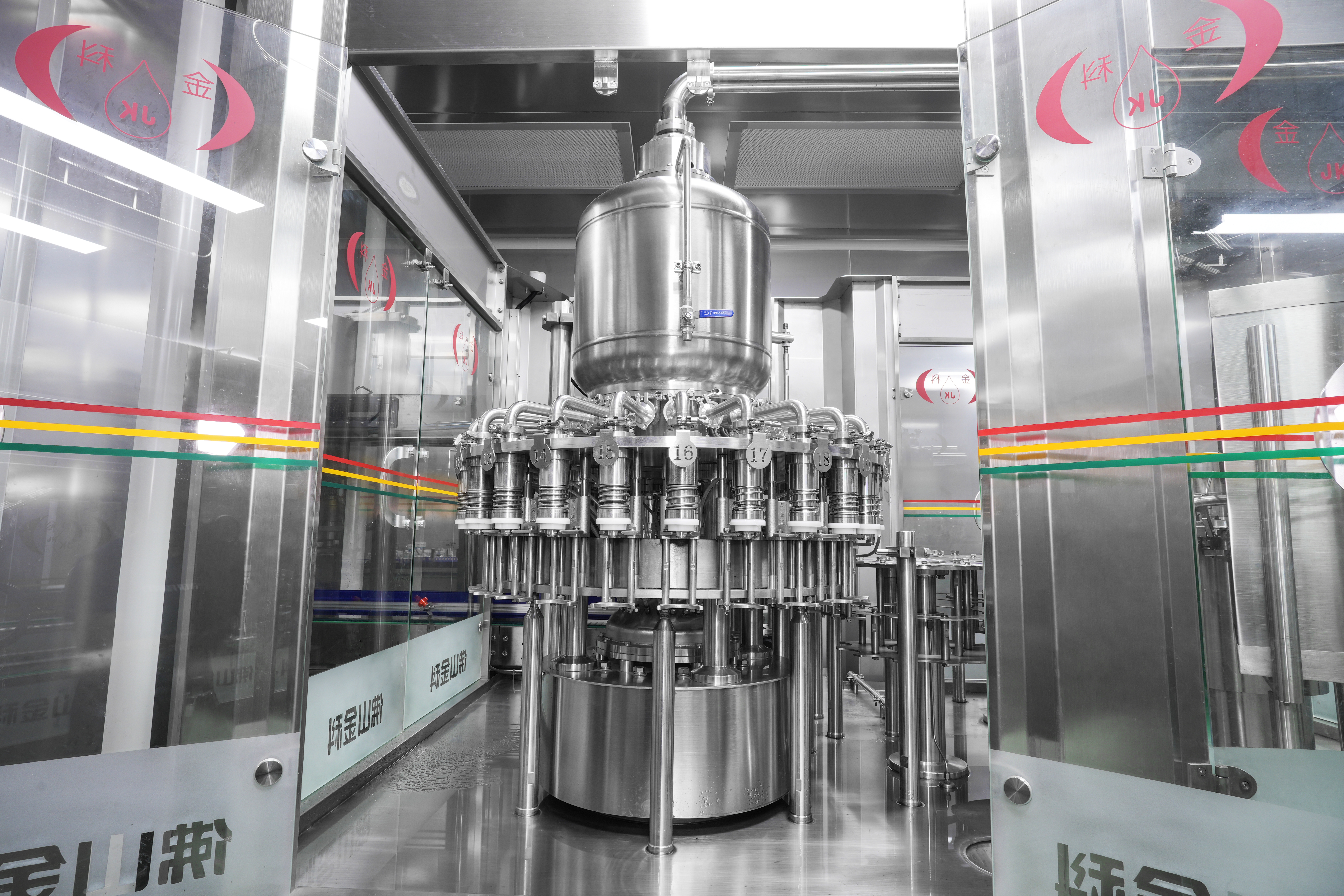

The air conveyor is directly connected to the three-in-one filling machine, and bottle transfer uses neck-holding transmission. The advantages of this method are:
1. Easy bottle type change and stable transfer.
2. Prevents secondary contamination of the bottle neck.
The production process of this machine is as follows: Bottles in the air conveyor are transferred by the bottle dividing star wheel onto the rinser of the three-in-one machine. The rinser’s rotary table is equipped with stainless steel bottle clamps that grip the bottle neck and rotate the bottle 180° along a guide rail, turning the bottle mouth downward. In a designated rinsing area, specially designed nozzles spray rinsing water to clean both the inside and outside walls of the bottle thoroughly. After rinsing and draining, the bottle is rotated back 180° by the clamp along the guide rail, returning the mouth to the upward position. The cleaned bottles are then transferred via a transition star wheel to the filling machine.
Upon entering the filling machine, the bottles are held by clamps on a lifting device that moves them up and down under cam control. The filling machine uses a constant-pressure filling method: the bottle mouth rises to open the filling valve and filling begins. Filling stops when the liquid reaches the level of the air return hole. After filling, the bottle mouth lowers away from the valve. The bottles pass through another transition star wheel into the capping machine.
In the capping machine, an anti-rotation knife holds the bottle neck to keep the bottle upright and prevent it from rotating. The capping heads revolve around the machine while simultaneously rotating on their own axes. Under cam control, the machine performs cap gripping, placing, screwing, and cap releasing actions to complete the entire capping process. Finished bottles are transferred from the capping machine to the discharge conveyor via discharge star wheels and then conveyed out of the three-in-one filling machine.


